The Many Sides of Johannes Brahms
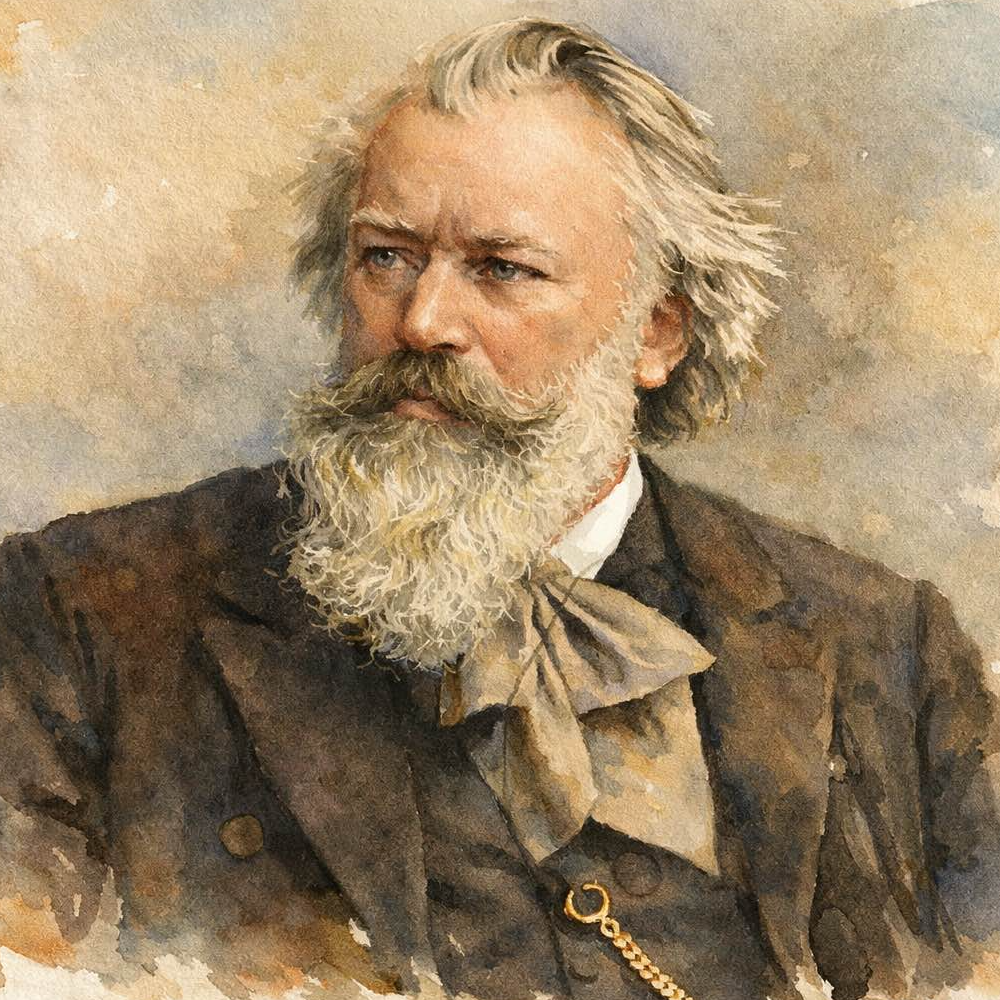
Johannes Brahms (1833—1897)
When we think of Johannes Brahms, we often imagine a serious, bearded composer sitting at his desk, writing music that is powerful, complicated, and sometimes difficult to understand. At the same time, what I find fascinating about Brahms is that behind this serious image was a man with a wonderful sense of humor, a complicated personality, and a life full of surprises. As a teenager, Brahms was so short of money that he published light piano arrangements and fantasies under the name “G.W. Marks” to help support his family. Imagine that! One of the greatest composers in history once had to hide behind a different name just to earn extra money. As a young pianist in Hamburg, he also played in dance halls and cafés, where he encountered the popular music and lively dance rhythms that would later influence his compositions. These experiences remind us that inspiration does not always come from a concert hall or a formal music lesson. Sometimes, the things we learn while simply trying to get through life become some of the most important influences on our art.
Brahms was also famous for his sharp wit, and some of the stories about him are almost as entertaining as his music. At a gathering, the wife of Johann Strauss II, the composer of The Blue Danube Waltz, asked Brahms to sign her fan. Instead of writing his own music, Brahms wrote the opening notes of Strauss’s famous waltz and added, “Alas, not by Johannes Brahms!” I love this story because it shows that even a great composer could appreciate the genius of another artist. Brahms did not need to pretend that everything wonderful had to come from him. He could recognize beauty in someone else’s work and make a joke about it. He was also known for being rather difficult at parties. On one occasion, as he prepared to leave a gathering, he reportedly announced, “If there is anyone here whom I have not insulted, I apologize.” Although his humor could be a little sharp, these stories remind us that great artists are human beings, too. They have their own peculiarities, insecurities, and ways of seeing the world. We should never assume that extraordinary talent means someone must have an extraordinary personality in every respect!
One of the most inspiring parts of Brahms’s life is the enormous amount of time he spent working on his First Symphony. He was deeply conscious of Beethoven’s greatness and understood how difficult it would be to write a symphony that could stand beside the masterpieces of such a towering figure. Rather than rushing to prove himself, Brahms spent more than two decades developing, revising, and refining his ideas before his First Symphony was published in 1876, when he was forty-three years old. The conductor Hans von Bülow famously called it “Beethoven’s Tenth,” recognizing the connection between Brahms’s achievement and Beethoven’s symphonic legacy. Think about what this means for us as musicians. We live in a world that often encourages us to accomplish everything as quickly as possible. We want to learn a piece immediately, perform it perfectly, and receive praise before we have had time to grow. Brahms teaches us that some achievements require years of patience, uncertainty, and careful thought. Taking a long time does not necessarily mean we are failing. Sometimes, it means we understand how much our work matters. We must learn to respect the process of becoming better, even when the results are not yet visible to others.
Perhaps the most surprising thing about Brahms is that, although he did not hold traditional religious beliefs, he kept a Bible beside his bed throughout his life. His A German Requiem also reveals something important about his outlook: instead of following the traditional Latin Mass for the dead, he selected biblical passages that offered comfort to the living. I find this especially beautiful because it reminds us that we do not always have to see the world in exactly the same way as someone else to discover meaning in what they create. Brahms could question religious traditions while still finding value in words that offered humanity comfort and hope. His life invites us to look beyond appearances, to remain curious about people who seem different from us, and to understand that even the most serious individuals may have a playful side hidden beneath the surface. Most importantly, his long struggle to complete his First Symphony reminds us that we should never measure our potential by how quickly we succeed. Whether we are practicing a difficult passage, preparing for an important performance, or trying to discover who we want to become, we must give ourselves permission to grow at our own pace. Greatness is not simply a matter of talent. It is also a matter of patience, honesty, courage, and the willingness to keep working until we have given our very best to something we love.