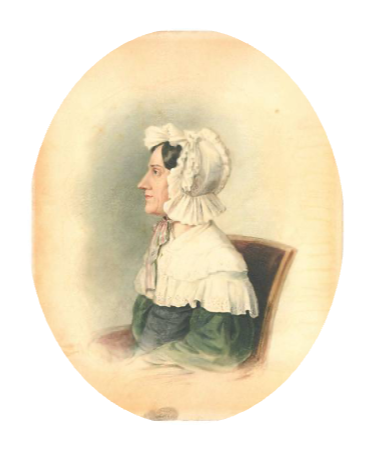
Portrait of Nanette Streicher by Ludwig Krones, 836
The piano we know today is the product of centuries of imagination, experimentation, and extraordinary craftsmanship. When Bartolomeo Cristofori, an Italian instrument maker, developed the first pianoforte around 1700, he introduced an instrument that would forever change the history of music. During the eighteenth century other important builders, including Gottfried Silbermann in Germany and Johann Andreas Stein in Augsburg continued to improve the instrument, making it increasingly responsive and expressive. Among these remarkable pioneers was a woman whose name deserves to be remembered alongside the greatest builders of her generation: Nannette Streicher.
Born Anna Maria Stein in Augsburg, Germany, in 1769, Nannette was the daughter of the distinguished piano builder Johann Andreas Stein. She was also an accomplished pianist, giving public performances when she was only seven years old. Following her father's death in 1792, she helped continue the family business with her younger brother, Matthäus. Two years later, she married Johann Andreas Streicher, a pianist and music teacher, and moved with him to Vienna. There the couple established a successful piano-making business that would eventually become one of the most respected manufacturers in Europe. Nannette was not simply the wife of a piano builder or the manager of a family enterprise; she was a highly skilled instrument maker in her own right. By 1802, she was directing the business independently of her brother, overseeing the development and production of instruments that became particularly admired for their tonal quality, strength, and expressive possibilities. At a time when women had very limited opportunities in technical and manufacturing professions, she established herself as an important figure in an overwhelmingly male industry. Her success was especially remarkable because she combined the sensibilities of a performing musician with the technical knowledge of an accomplished craftswoman.
Nannette Streicher's connection with Ludwig van Beethoven is one of the most interesting relationships between a composer and an instrument maker in musical history. Beethoven knew the Stein family and developed a close friendship with Nannette and her husband after they settled in Vienna. He greatly appreciated the quality of their pianos, and the Streicher workshop built instruments specifically for him. Their relationship was more than a commercial arrangement: Beethoven frequently discussed the capabilities of the piano with Nannette and offered suggestions about improvements that might make the instrument better suited to his increasingly ambitious compositions. He wanted a piano capable of producing tremendous power while retaining delicacy, clarity, and a wide range of tonal colors. As his hearing progressively deteriorated, the importance of having an instrument that responded to his particular needs became even greater. In 1817, Beethoven requested that Nannette make adjustments to a piano to accommodate his hearing difficulties.
Their friendship also extended into his personal life. Beethoven trusted her judgment and frequently sought her assistance with practical matters, particularly during the difficult period when he was responsible for raising his nephew Karl. Nannette helped him with household arrangements and domestic concerns, offering a degree of practical support that Beethoven, who could be notoriously difficult to manage, greatly needed. It is remarkable to think that one of the greatest composers in history depended not only upon Nannette's musical and technical expertise but also upon her friendship and understanding.
When we hear Beethoven's piano sonatas, we naturally think about his extraordinary imagination, his revolutionary musical language, and his ability to express emotions that seem almost beyond words. Yet the instrument for which he composed was always evolving, and the work of builders such as Cristofori, Silbermann, Stein, and Streicher helped make his musical achievements possible.
Beethoven did not simply accept the piano as it existed; he continually challenged its limitations, and builders such as Nannette responded to those challenges with ingenuity and dedication. Her legacy is especially inspiring because she succeeded through a combination of musical understanding, technical knowledge, and entrepreneurial determination at a time when such accomplishments by women were rarely acknowledged.
For young pianists, there is an important lesson in this history: a musical instrument is never merely an object upon which we play. It represents the accumulated intelligence, imagination, and craftsmanship of generations of people who have devoted their lives to expanding the possibilities of music. The next time you sit down to play Beethoven, remember that somewhere behind those extraordinary compositions stands Nannette Streicher, a remarkable woman whose hands helped build the very instrument through which his genius could speak.