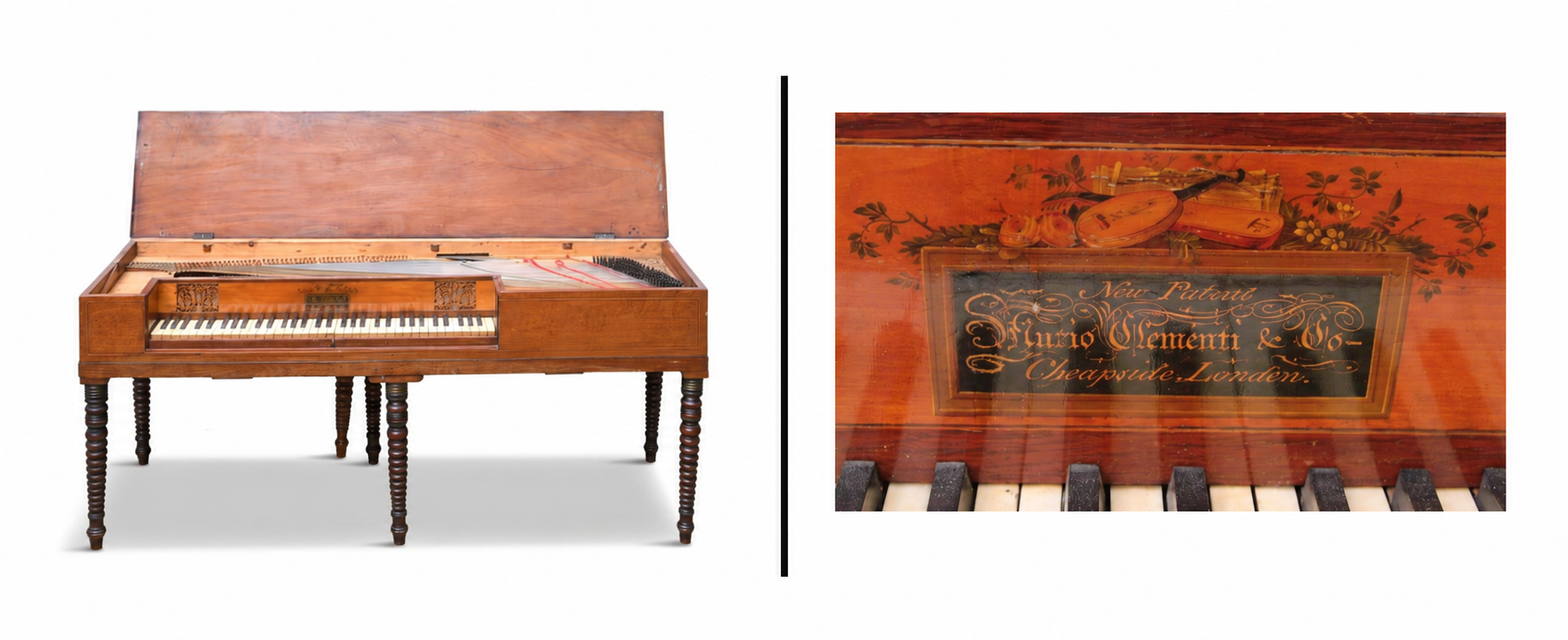
A Clementi Piano, ca. 1820
Continuing this week’s examination of the life and work of Muzio Clementi, I would like to discuss his work as a composer.
When we think of the great composers who shaped the history of the piano, names such as Mozart, Beethoven, and Chopin often come immediately to mind. Yet Clementi is another composer whose contributions deserve our attention. He demonstrated extraordinary musical ability at an early age and eventually settled in England, where he established himself as a celebrated pianist, composer, teacher, and publisher. Although he lived during the same period as Mozart and Beethoven, Clementi developed a musical personality distinctly his own. His compositions helped transform the piano from an instrument still finding its identity into a vehicle capable of remarkable technical brilliance, expressive depth, and artistic independence.
One of the most fascinating aspects of Clementi's music is how thoroughly he understood the physical and expressive possibilities of the piano. During his lifetime, the instrument was evolving rapidly, gradually replacing the harpsichord as the preferred keyboard instrument. Unlike the harpsichord, whose strings are plucked, the piano allows a performer to control volume and expression through the force and sensitivity of the fingers. Clementi recognized the enormous artistic potential of this development and wrote music that explored it with imagination and precision. His sonatas frequently feature rapid scales, brilliant arpeggios, powerful chords, and passages requiring the hands to move independently across the keyboard. These were not simply technical obstacles designed to impress an audience; they were ways of discovering what the piano could accomplish. Clementi understood that technique was most meaningful when it served a musical purpose, allowing a performer to communicate excitement, elegance, drama, and tenderness through the instrument.
Clementi's significance becomes especially clear when we consider his influence on generations of pianists. His Gradus ad Parnassum, a collection of one hundred studies published between 1817 and 1826, became an important resource for developing keyboard technique. The Latin title suggests a journey toward the summit of artistic achievement, and the collection reflects Clementi's belief that musical excellence requires both discipline and imagination. His studies challenge pianists to develop finger independence, precision, control, and clarity while also encouraging an understanding of musical structure and expression. Beethoven admired Clementi’s piano sonatas and recommended them to his students, recognizing their value in developing both technique and musicianship. Clementi's influence extended beyond his compositions, too: he became a successful piano manufacturer and music publisher, helping advance the instrument and the musical culture that surrounded it. In this sense, Clementi did not merely write for the piano as it existed; he helped shape the instrument's future and the way musicians learned to play it.
For young pianists, Clementi offers an especially valuable lesson: understanding an instrument is about much more than mastering its notes. When you practice one of his sonatas, you are exploring the ideas of a composer who understood how the fingers, hands, and imagination could work together to create something greater than technical perfection alone. A rapid passage should possess direction; a sequence of chords should have character; and even the simplest melody should communicate a clear musical thought. Clementi reminds us that technique is not the destination but the means by which we reach it. His music may sometimes appear modest beside the emotional intensity of Beethoven or the poetic lyricism of Chopin, but its influence can be heard in the generations of composers and pianists who followed him. By studying Clementi, we gain more than a foundation for playing the piano well: we discover an essential chapter in the instrument's evolution and learn to appreciate how a composer's understanding of the piano can expand the possibilities of music itself.