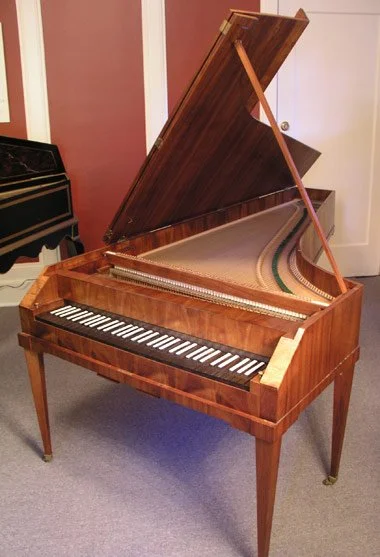
Replica of a piano built by Nannette Streicher, 1804
Continuing our discussion of Nannette Streicher, here are some very interesting facts about her business life:
1. She inherited and continued an established business. Following her father Johann Andreas Stein's death in 1792, Nannette took responsibility for continuing his piano-making workshop. She had already acquired considerable technical knowledge and practical experience through working alongside him.
2. She established an independent enterprise. After initially working with her brother Matthäus in Vienna, the siblings separated professionally in 1802. Nannette then established her own company, operating under the name Nannette Streicher, née Stein. This distinction is important: she was not merely assisting her husband or brother. She was running her own manufacturing enterprise.
3. She became a major manufacturer. Her company eventually produced approximately 45–65 grand pianos annually, an impressive output for handcrafted instruments at that time. Her pianos were sought after by distinguished musicians and became highly regarded throughout Vienna and beyond.
4. She was an innovator, not simply a manufacturer. Nannette continually improved the construction of her instruments, adapting them to the demands of increasingly ambitious composers and performers. Her designs included stronger piano structures and improvements in tonal balance and expressive capabilities. Her instruments were particularly admired for combining power with delicacy.
5. She built a lasting family enterprise. In 1823–24, her son Johann Baptist joined the business, helping establish the next generation of the Streicher piano-making tradition. Following Nannette's death, he continued the company, which eventually achieved an international reputation and remained in operation until 1896.
One achievement I would especially like to share is that Nannette was responsible for much more than the physical construction of pianos. She understood the entire manufacturing process, including production, quality control, sales, delivery, and customer relations. Her husband, Andreas, contributed substantially to the business's administration, correspondence, and promotion. Their partnership combined her technical and musical expertise with his commercial and organizational abilities.
Nannette Streicher was a woman who built a successful manufacturing company in an era when women were rarely recognized as leaders in technical industries. She did not simply inherit her father's reputation; she expanded upon it, developed her own instruments, cultivated an international clientele, and created a business that survived for generations.