Mazeppa—A Story Without Words
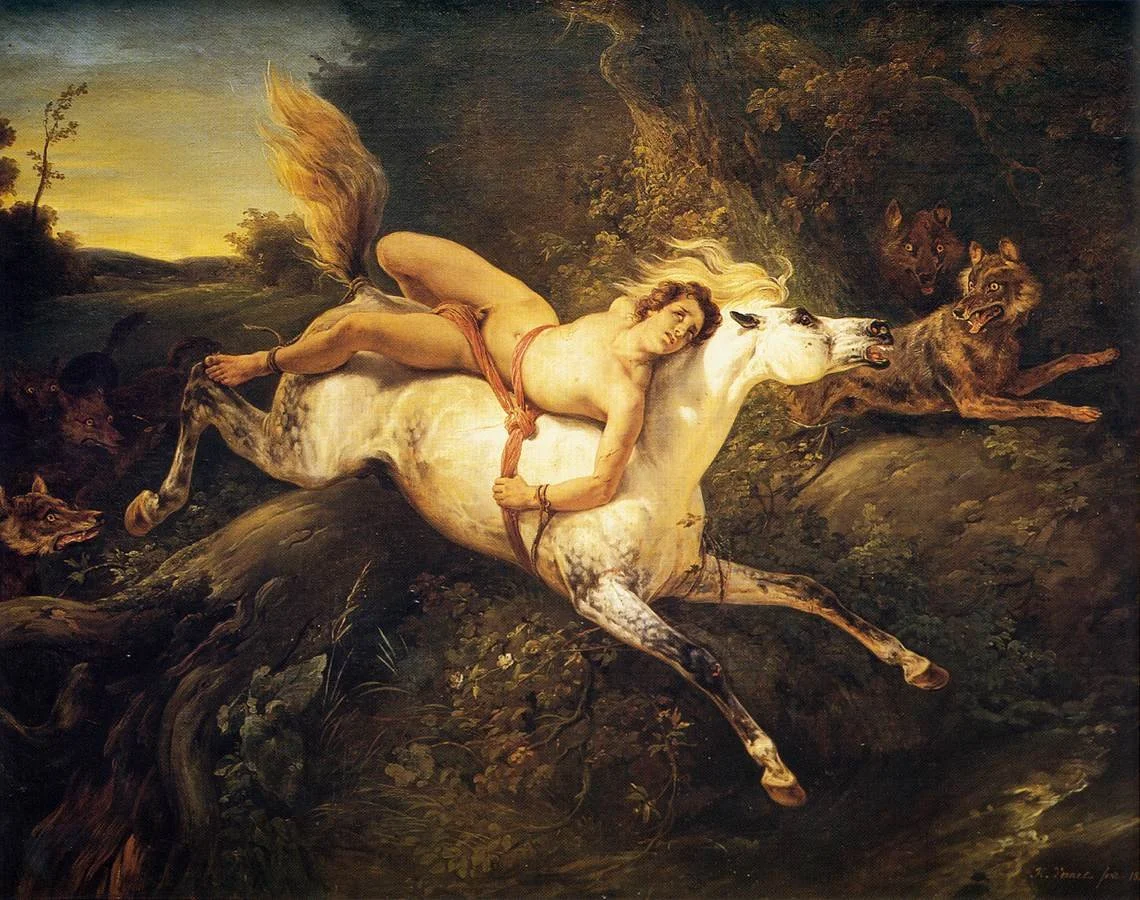
Mazeppa and the Wolves by Horace Vernet
My very real fascination with “Mazeppa” as a piano work continues, particularly when I consider the fact that Liszt was known to be interested in the idea of an instrumental work could actually tell a story without words.
The painting above is based on the story of Mazeppa being tied to a horse that was then let loose in the forest as punishment for his crime. As one listens to the piece it is hard not to notice that the rhythmic figure clearly suggests a horse, with the repeated themes representing Mazeppa’s journey.
One also can notice how technical aspects of the composition, and the increase of their complexity tend to suggest danger, or even physical exhaustion.
In my mind, this work is not about merely playing something that is difficult. It is instead about Liszt working to make pianistic technique a character in the art of storytelling, which for me makes the work seem even more masterful.
As I see it, one does not merely play this work, but uses every note, every chord, like characters in a novel, in order to tell a story.
More to come in my next post.