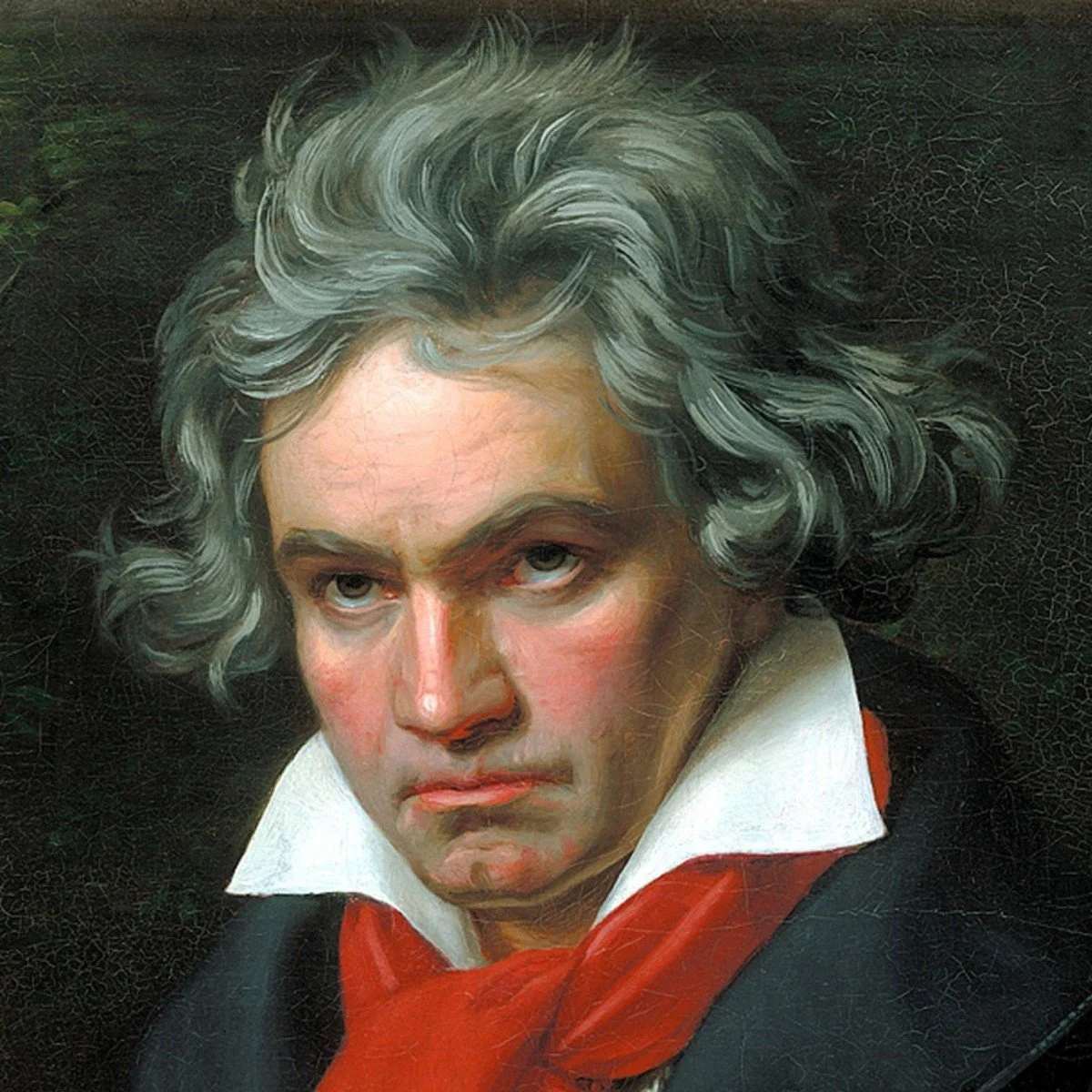
Ludwig van Beethoven (1770—1827)
When we think of Ludwig van Beethoven, we often imagine a serious man with wild hair, a determined expression, and music filled with enormous emotion. We know his symphonies, sonatas, and concertos, but there are many fascinating details about his life that reveal a more personal side of this extraordinary composer. For example, although we traditionally celebrate December 16 as his birthday, we do not know his exact date of birth. We know that he was baptized on December 17, 1770, and December 16 is generally accepted as the most likely date. As a child, Beethoven was trained rigorously by his father, who hoped to present him as a musical prodigy. Yet Beethoven’s journey was not simply a story of natural talent. It was also a story of determination, hard work, and a young boy gradually discovering the remarkable musical voice that would one day change the world.
One of the most interesting things about Beethoven is that, despite the powerful and sometimes fierce personality we associate with him, he had a wonderful sense of humor. His letters reveal a man who enjoyed wordplay, teasing his friends, and expressing himself with an unfiltered honesty that could be both amusing and exasperating. He was also surprisingly particular about his everyday life. He moved frequently, sometimes changing residences several times in a single year, and his correspondence reveals how much time he spent dealing with practical matters alongside his musical work. He negotiated with publishers, arranged performances, managed his finances, and worried about the details of getting his compositions into the world. This reminds me that even the greatest composers were not living entirely in a magical world of music. They had errands to run, bills to pay, relationships to manage, and ordinary problems to solve, just as we do today.
Perhaps the most heartbreaking aspect of Beethoven’s life was his struggle with hearing loss. Imagine being a pianist and composer whose greatest joy is sound, only to discover that the world of sound is gradually disappearing. Beethoven began to experience serious difficulties with his hearing while still a relatively young man, and by the later years of his life, he was profoundly deaf. Yet he continued composing some of his most extraordinary works, including music that demanded enormous imagination and artistic courage. He did not simply give up because one of the most important tools of his profession was being taken away from him. Instead, he continued to explore, question, and create. His relationship with his nephew Karl also reveals a less familiar side of his character. Beethoven fought a lengthy legal battle to become Karl’s guardian, hoping to provide the boy with the family life he himself had never truly known. Their relationship, however, became difficult, partly because Beethoven’s intense love and concern often turned into excessive strictness. His story reminds us that even extraordinary people can struggle to understand those they love.
Finally, there is something I find especially inspiring about Beethoven’s creative process. He did not always compose effortlessly, waiting for beautiful melodies to appear fully formed in his imagination. Thousands of pages of musical sketches survive, showing him revising, reconsidering, and reshaping musical ideas until they expressed what he wanted to say. In other words, even Beethoven had to work through uncertainty. The music that sounds inevitable to us today was often the result of countless decisions, corrections, and moments of frustration. As young musicians, we sometimes believe that great artists possess a secret that allows them to succeed without difficulty. Beethoven teaches us something different: greatness is not the absence of struggle, but the willingness to continue despite it. We may not all compose a Ninth Symphony, but we can learn from his example whenever we face a difficult passage, an unexpected disappointment, or a goal that seems beyond our reach. His life reminds me that our limitations do not have to define us. What matters is the imagination, courage, and persistence with which we choose to meet them.