Little Poland
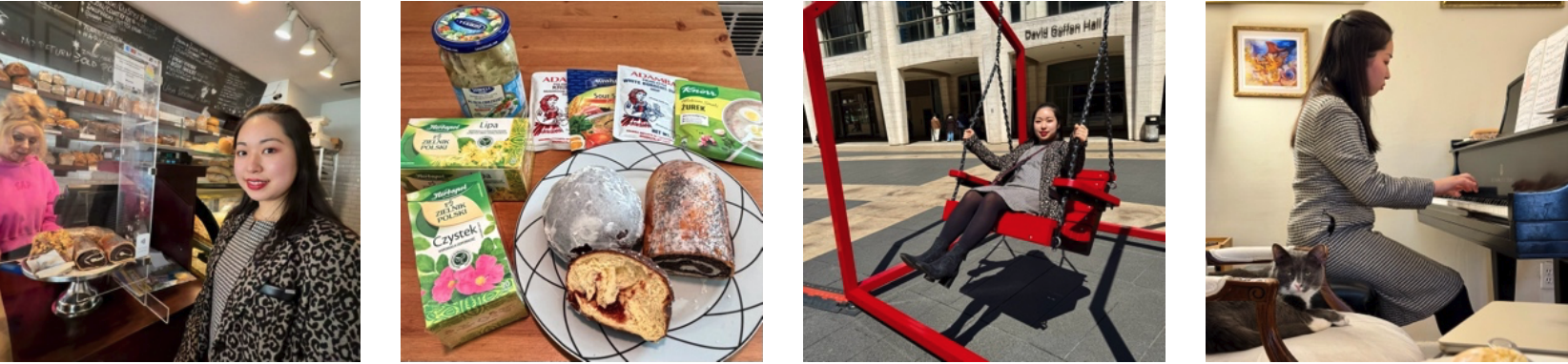
From left to right: Old Poland Bakery; my purchases at Kiszka; I spotted a red swing that had popped up in front of the Met Opera fountain, so I headed over there right away(!); today's practice session. Tamino was—unusually enough—sleeping right beside me except for the moment I accidentally played a wrong note, at which point he woke up immediately!
With just about a week remaining until my concert at The Church in Sag Harbor—and less than a month until my solo debut at Carnegie Hall—I find myself right in the final stretch. At this stage, my work feels less like mere "practice" and more like a quest to discover even more exquisite nuances within these pieces, deepening my love for them even further. While I often uncover new things to cherish through my discussions with Mr. Cosmo, I also believe that stepping out on an adventure can be a source of great inspiration.
In fact, I woke up early today, finished my practice session on the digital piano ahead of schedule, and headed out once again to Brooklyn’s Polish neighborhood. My mission was to taste a paczek—a Polish doughnut filled with rose jam—the very kind that Chopin himself might have enjoyed. However, what I gained went far beyond just the paczek; hearing the Polish language spoken live, and observing how the smiles of the Polish people differed so distinctly from those in regions like Italy or France, provided me with a wealth of insights for my musical performance. This was because the experience completely transformed my impression of Poland.
The places I visited were the Old Poland Bakery
https://old-poland-bakery.res-menu.net/
This is a Polish bakery located in Greenpoint, Brooklyn
I also went to the grocery store across the street, the Nassau Meat Market, known as Kiszka
https://nycitylens.com/polish-greenpoints-iconic-kiszka/
On a building at a nearby intersection, the name "Mazur" was written in huge letters! I was surprised! This could either be a reference to people who come from Mazowsze (Masovia) the region in northeastern Poland, or someone associated with the lively Polish folk dance known as the mazur.
The bakery owner, the staff at the Polish grocery store across the street, and the shoppers—everyone there, save for us, was speaking in Polish; it was enough to make me completely forget that I was still in New York. In addition to paczki (filled with plum and rose jams), I purchased several other items recommended by the shop owner: makowiec (a poppy-seed roll cake consisting of a soft, slightly sweet yeast dough rolled around a dense, rich filling of ground poppy seeds, honey, nuts, and citrus peel), a quintessential Polish pastry; herbal teas (Lipa—Linden: effective for kidney issues, coughs, and the flu, and also possessing pain-relieving properties; czystek—Rockrose: a health tea prized for its potent antioxidant, antiviral, and antibacterial effects, as well as its high antihistamine properties, aiding in immune system enhancement, inflammation relief, and detoxification); Polish pickled herring—seasoned quite differently from its Scandinavian counterparts; and even some traditional Polish soup bases.
Now, having had this brief experience of immersing myself in Polish culture, has my musical performance changed at all? I firmly believe that the inherent rhythms and flow of a land's language are intimately intertwined with its music. As a Japanese person, even when performing Western classical music, a certain "Japanese quality" may inevitably surface in my playing—and perhaps that is only natural. However, I believe it is crucial to begin by researching the composer's historical context, biography, personal statements, cultural milieu, customs, social circle, and even their dietary habits. By doing so, one can discover—within the very fabric of each musical phrase—the "connective words," the specific "vocabulary" of emotion, and the rhythms that give the music its unique voice.
Compared to donuts from any other country, Polish paczki possess a remarkably dense and substantial dough. They are also quite rich and oily; indeed, one might find it difficult to finish a whole one in a single sitting—even if one didn't have the famously delicate appetite of Chopin! The jam filling, on the other hand, was pleasantly understated in sweetness with a distinct tartness—light enough in texture that one could easily eat it by the spoonful.
When I searched online for "foods favored by composers," I stumbled upon some truly fascinating trivia. For instance, Beethoven—who famously ground exactly sixty coffee beans every morning for his brew—was apparently quite fond of macaroni and cheese. Or Liszt, who in his later years suffered from dental problems and consequently subsisted on soft-boiled asparagus.
The day of the performance is fast approaching, but I intend to keep searching for more things to love and cherish—enjoying every step of the journey along the way!
Tap an icon below to share this blog on social media, email, or your favorite messaging app.