Leopold Mozart
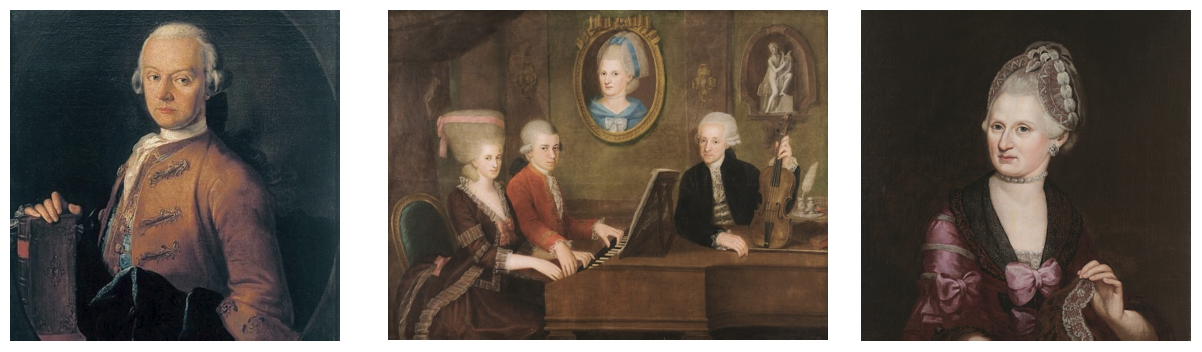
From left to right, Leopold Mozart; a portrait of the Mozart family, Nannerl, Wolfgang, Anna Maria (shown in the frame), and Leopold; Anna Maria Mozart
As I think about Leopold Mozart, the father of Wolfgang, I feel it is important to look at his role not just as father, but also a valuable educator.
Leopold Mozart’s most famous work is titled Versuch einer gründlichen Violinschule, or “A Treatise on the Fundamental Principles of Violin Playing.” Published in the same year that Wolfgang was born, it is still considered very influential as a work for providing insight into eighteenth-century performance and its historical interpretation.
Having first taught the piano to Mozart’s older sister, known as Nannerl, when young Mozart began experimenting at the keyboard before he could even read or write, his father soon realized that he was dealing with a true prodigy, which led him to take on many roles for the young Mozart, among them teacher, manager, publicist, travel organizer, and career strategist.
Wolfgang and his sister would go on to perform, thanks to his father’s hard work and industry, before royalty, aristocrats, and intellectuals while still a child. Leopold carefully organized these appearances, presenting both children as astonishing prodigies, the only two of his seven children surviving infancy. It also is important to note that Leopold himself was a composer, and wrote symphonies, serenades, sacred music, and keyboard works, as well as concertos and chamber music, although he was ultimately overshadowed by his son.
While the greatest aspect of Leopold Mozart’s legacy is clearly intertwined with his son’s career, he is still considered one of the greatest music educators in history, because of his having played such an essential role in shaping his son Wolfgang’s genius.
What remains therefore in terms of his legacy is the person responsible for having taught one of the greatest composers of all time, while also training him in ways that allowed Wolfgang to use his talent across musical genres and instruments in ways that keep his music as alive and fresh today as when it was first composed.
Tap an icon below to share this blog on social media, email, or your favorite messaging app.