Chopin and Liszt: Friends and Rivals?
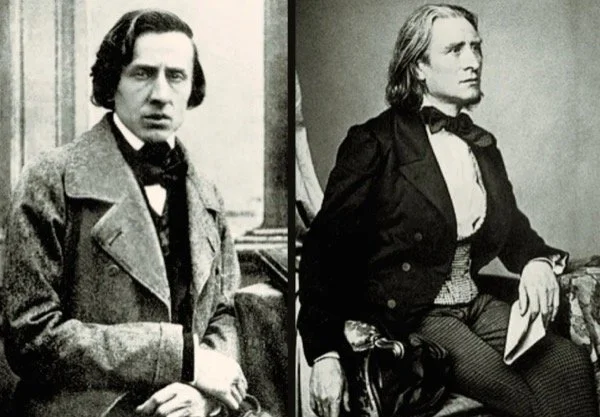
Frédéric Chopin and George Liszt (composite image)
Have you ever had a friend who was very different from you, but whose talents you admired so much that they inspired you to become better at what you do? This is something we can learn from the fascinating friendship between Frédéric Chopin and Franz Liszt, two of the greatest pianists and composers of the nineteenth century. They met in Paris during the 1830s, when both were establishing themselves as extraordinary musical talents. Although they approached music and life very differently, they recognized something exceptional in one another. Liszt was outgoing, charismatic, and loved performing for large audiences. He was famous for his astonishing technique and theatrical performances. Chopin, on the other hand, was quiet, sensitive, and preferred playing for small groups of people in intimate settings. Yet Liszt greatly admired Chopin's beautiful melodies, imaginative harmonies, and revolutionary understanding of the piano. Chopin, in turn, recognized that Liszt possessed a technical ability that was almost beyond human imagination. They were different, but they understood that each had something extraordinary to offer the musical world.
One of the most beautiful expressions of their friendship was Chopin's dedication of his Twelve Études, Op. 10, to Liszt. These études, published in 1833, were not simply exercises designed to improve finger technique. Chopin transformed the étude into something much greater: a musical work that could be technically demanding while expressing extraordinary poetry, emotion, and imagination. By dedicating these pieces to Liszt, Chopin was acknowledging his admiration for another pianist whose abilities he deeply respected. Liszt was equally impressed by the works and helped introduce them to audiences through his performances. There is a wonderful story about Liszt playing one of Chopin's études in a way that Chopin felt was not quite what he had intended. When Chopin challenged him about his interpretation, Liszt reportedly invited him to demonstrate how the piece should be played. Chopin sat at the piano, and Liszt supposedly dimmed the lights so that everyone could concentrate on the music rather than the pianist. I love this story because it reminds us that even the greatest musicians can have different ideas about how music should be interpreted. It also reminds us that respecting another musician does not mean that we must always agree with them.
Of course, their friendship was not without disagreements, and as the years passed, the two musicians gradually became less close. Interestingly, their separation may have had as much to do with their personal lives as with their music. Both men were involved in complicated romantic relationships, and their respective companions, George Sand and Marie d'Agoult, did not always get along. Liszt later recalled that the two women's disagreements had affected his friendship with Chopin, explaining that they felt obligated to remain loyal to the women they loved. There were also differences in their musical personalities. Liszt enjoyed experimenting with interpretation and adding his own expressive flourishes, while Chopin was much more protective of his compositions and the details he had written into the score. By the middle of the 1840s, they saw considerably less of one another. Yet it is important not to mistake distance for hostility. Chopin still referred to Liszt as his friend in letters as late as 1848, just one year before his death. When Chopin died in 1849, Liszt honored his memory by writing a biography of him, published in 1851. Their relationship reminds us that friendships, like musical careers, can change over time without losing the significance of what they once meant.
After Chopin died in 1849, Liszt wrote a biography of his former friend, published in 1851, as a tribute to the extraordinary musician he had known and admired. Their friendship teaches us something very important as young musicians: we should never feel that we must become exactly like the people we admire. Liszt did not need to become Chopin, and Chopin did not need to become Liszt. Each developed a unique musical identity, and that is precisely what made them so remarkable. As pianists, we often compare ourselves with others. We listen to someone with better technique, a more beautiful sound, or greater confidence on stage, and sometimes we begin to question our own abilities.
Instead, we should learn to admire what others do well while continuing to discover what makes our own musical voices special. Perhaps the greatest gift we can receive from another musician is not the desire to imitate them, but the inspiration to become the very best version of ourselves.