Beethoven’s Piano Concerto No. 3: Understanding the Entire Work
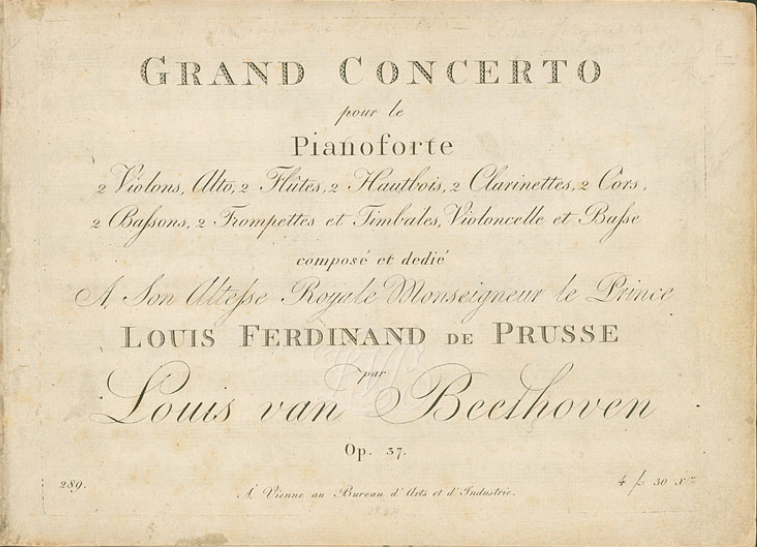
The title page of the first edition of Beethoven’s Piano Concerto No. 3 (Wikipedia).
Having worked through all of Beethoven’s Third Piano Concerto, I am now spending time examining the different movements in order to better determine how the work fits together as a whole, which offers some very interesting observations.
One of the things that fascinates me is how different the three movements are from one another, while still belonging to the same musical work. The First Movement, in C minor and marked Allegro, is powerful, serious, and dramatic. It begins with the orchestra, almost as if it is telling us the story before the pianist enters. The movement is built on the principles of the sonata form, with contrasting themes that are developed, transformed, and eventually brought back. As a pianist, I have to think about the overall structure of the movement rather than simply playing one beautiful passage after another, balancing the power of the work against its mystery. Beethoven asks the pianist to create a sense of drama and direction, so that the audience feels that the music is going somewhere.
The Second Movement, Largo, is almost the opposite in character. After the intensity of the C-minor First Movement, Beethoven moves into E major, and a completely different atmosphere. The music becomes peaceful, intimate, and deeply lyrical. I sometimes think of this movement as a conversation between the piano and the orchestra rather than a battle between them. The pianist must be especially careful here because there is nowhere to hide behind technical brilliance. Every phrase has to breathe, and every note must have meaning. The beautiful simplicity of the melody can be deceptive. Playing slowly and softly is not necessarily easier than playing loud and fast; in fact, it can require even greater concentration. Beethoven leaves space between the sounds, and the pianist has to understand how to make that silence part of the music. For me, the Second Movement teaches an important lesson: sometimes the greatest expression comes not from playing more, but from listening more carefully.
Then Beethoven suddenly changes the atmosphere again with the Third Movement, a fiery Rondo in C minor. If the Second Movement feels like a quiet conversation, the Finale feels like a race. The principal theme returns again and again, and each time it seems to gather more energy. There is humor, excitement, rhythmic drive, and a sense of determination. The pianist must have tremendous clarity and rhythmic precision, because the movement can easily become too fast or too heavy. One of the challenges is maintaining the character of the music while also managing its considerable technical demands. Beethoven eventually transforms the darkness of C minor into the brightness of C major, and this change is enormously important. It feels almost like a victory—not a simple, cheerful victory, but one that has been earned after everything that came before. The contrast between the movements makes this transformation even more powerful.
When I perform or study this concerto, I therefore try not to think of the three movements as three separate pieces. They are more like three chapters of one great story. The First Movement introduces conflict and strength; the Second gives us a moment of reflection and tenderness; and the Third brings energy, humor, struggle, and finally triumph. The pianist must change character completely from one movement to the next while still remembering that all three belong to Beethoven. This is one of the reasons I find the concerto so rewarding to study. It teaches us that being a musician is not simply about playing the right notes. We must understand character, structure, contrast, silence, rhythm, and emotion. Most importantly, we must learn how to take the listener on a journey—and Beethoven’s Third Piano Concerto gives us one of the most extraordinary journeys in the piano repertoire.