Beethoven’s Piano Concerto No. 3: First Movement Cadenza
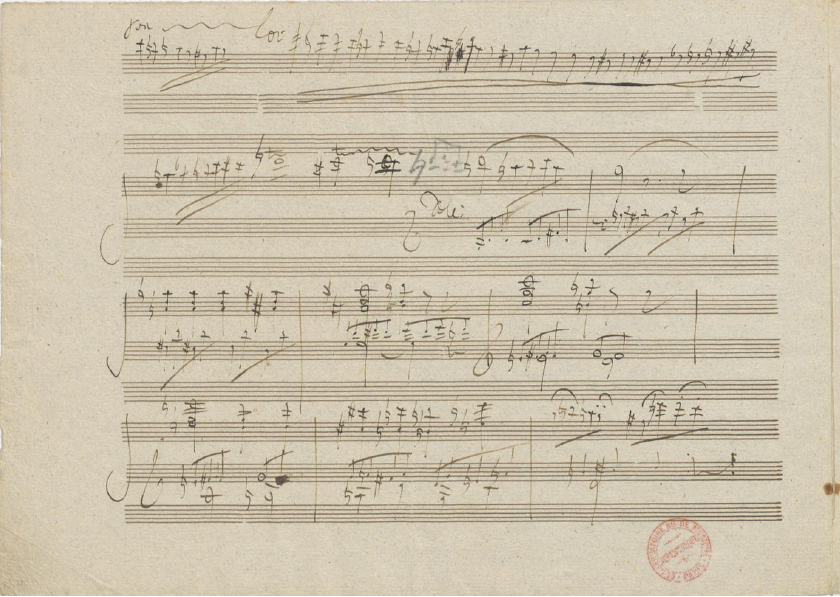
The first movement cadenza of Beethoven’s Piano Concerto No. 3 (Wikipedia).
A cadenza is a moment toward the end of a movement where the orchestra stops playing and the soloist takes over, with music based on the themes of the particular movement. Originally cadenzas were improvised by the soloist, but as time went on composers added their own versions, as Beethoven has done with the First Movement of this Third Piano Concerto. Other performers have weighed in and written their own cadenzas including such notable musicians as Franz Liszt, Clara Schumann, Ernest Hutcheson, Edwin Fisher, Carl Reinecke, Wilhelm Kempff and Charles-Valentin Alkan to name a few. At the premiere of the Concerto in 1803, Beethoven improvised the cadenza, but in 1809, he wrote it out most probably for his student, Archduke Rudolph. Although a cadenza is based on one or more themes from a movement, it should be played differently in that it should sound improvised.
My teacher, Cosmo Buono, has encouraged me to use a great deal of freedom in terms of rubato and dynamics to create this effect. Since I am playing alone, I can do interpretive things that are not readily possible when playing with an ensemble. Cadenzas usually end with a trill by the soloist in order to signal that the cadenza is over the movement continues.
What makes Beethoven’s cadenza so fascinating is that it is not simply a collection of difficult piano passages. It has a carefully organized musical structure of its own. Beethoven takes ideas that we have already heard during the movement and transforms them through imitation, sequence, changes of register, harmonic exploration, and increasingly brilliant piano writing. In other words, he is doing in miniature what he has done throughout the entire concerto: taking a small musical idea and asking, “What else can this become?” The cadenza therefore behaves almost like a compressed development section. We hear familiar rhythmic and melodic ideas, but they are placed into new harmonic surroundings, where they become more dramatic and unstable. This is one reason the cadenza feels so natural within the movement rather than sounding like an unrelated virtuoso showpiece.
For a pianist, this means that learning the notes of this cadenza is only the beginning. You must understand its architecture: where an idea begins, where it is developed, where the harmony travels, where the tension increases, and how Beethoven finally releases that tension. It is tempting to play a cadenza as though it were simply an opportunity to demonstrate speed and power, but that misses the real point. Even the most difficult passages should sound as though they are growing naturally out of the music. I like to think of this cadenza as a conversation between Beethoven the composer and Beethoven the pianist. The composer gives us the musical materials; the pianist must discover how those materials should speak. When we understand that, the cadenza becomes much more than a display of technique—it becomes the dramatic moment in which the entire first movement seems to pass through the imagination of the pianist before the orchestra returns to finish Beethoven’s argument.