Love Notes
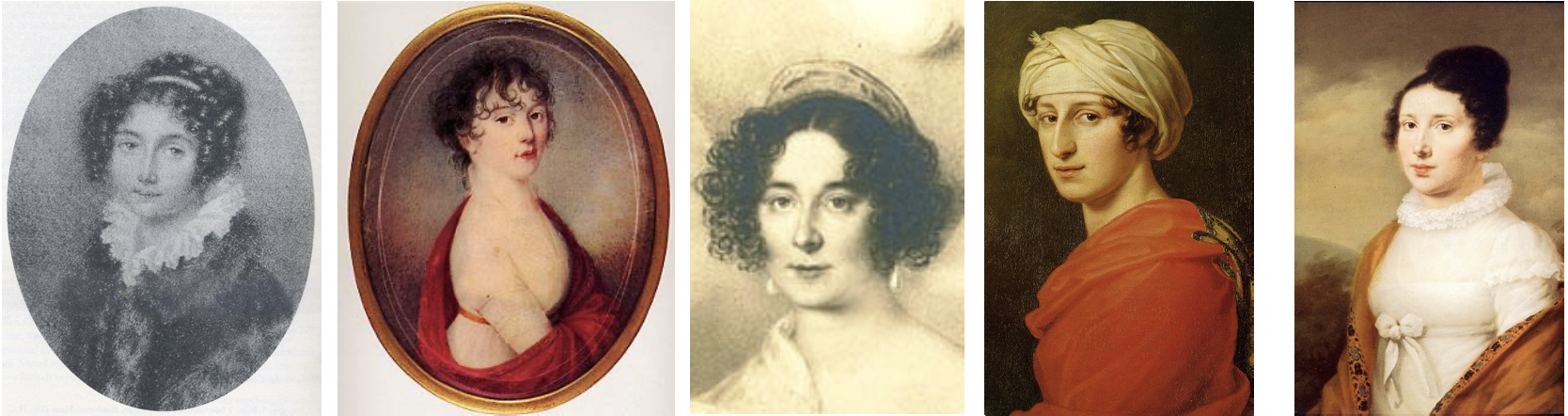
From left to right: The great loves of Beethoven’s life. Josephine Brunsvik, (1779-1821), his likely "Immortal Beloved”; Giulietta Gicciardi (1782-1856), the Countess to whom he dedicated his “Moonlight Sonata”; Therese Malfatti (1792-1851), often cited as the inspiration for “Für Elise; Antonie Brentano (1780-1869), an Austrian aristocrat and philanthropist; Elisabeth Röckel (1793-1883), a German soprano.
Historians have made it very clear that although Beethoven never married, he had many love interests. In addition to those above there were others such as Eleonore von Breuning, (1771-1841) known to be his first love, and singer Amalie Sebald (1787-1846).
His dedication of works to some of these women would also seem, from an historic standpoint, to signal he had a romantic interest in them, as would speculation that his famous “Immortal Beloved” letter, though not naming a woman in particular, was meant for Josephine Brunsvik, and details the most passionate and ardent feelings.
What I personally find significant about these love affairs however is that Beethoven channeled them into what is arguably some of the most romantic music ever written, and that the passion and pathos with which he composes taps into universal feelings of emotion that keep his music both popular and relatable more than two hundred and fifty years after his death.
I like to think then that works such as the Moonlight Sonata and his Für Elise are the real love letters. Not written with words, but with notes, chords and musical phrases that signaled deep and intense sentiments made all the more powerful because they were never fully realized: As if every piece he ever dedicated to a woman began in his mind with the words “If only…” or perhaps “What if…”.
Tap an icon below to share this blog on social media, email, or your favorite messaging app.