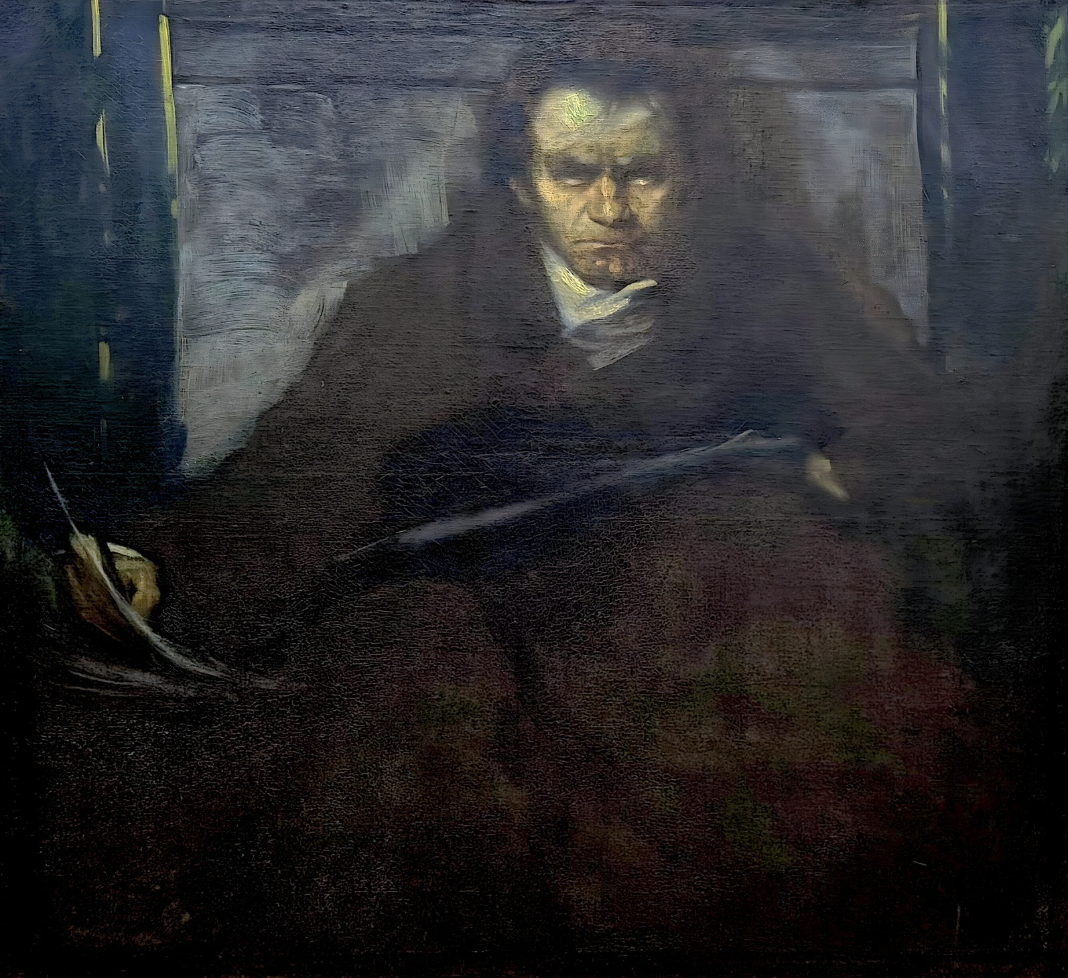
A portrait of Ludwig van Beethoven painted in 1902 by photographer Edward Steichen. (Photo courtesy of GMG Public Relations)
In New York this past weekend there was the discovery of a portrait of Beethoven done by the famous photographer Edward Steichen in 1902.
The painting is itself significant because of Steichen going on to become a world-famous photographer; because he painted it when he was only 23 years old; and because from an artistic standpoint it is considered to represent the cross section of Steichen’s work between music, art, and modern culture. The portrait is described as a “moody” depiction of Beethoven, painted 75 years after his death, and is appraised to be worth almost a million and a half dollars.
While the discovery of the painting is nothing short of miraculous, not to mention it is one of the few of his own paintings Steichen did not burn in a huge bonfire once he decided to turn his attention to photography, I couldn’t help but ask myself why he chose Beethoven as a subject. As I researched the story I discovered that he chose to do it out of a love for music, but that answer still did not prove satisfactory enough. Surely there were other composers he could have painted, other musicians, even other scenes from classical music.
What I think becomes important in examining this painting and its subject however is the fact that over the centuries Beethoven has grown to become more than a man, a musician, and a composer. He has become a symbol of triumph over adversity. And while the beauty of his music is undisputed, to know that he actually was never able to even hear some of his own compositions takes him from the realms of being an amazing human being, to a place where he rightfully can be considered a legend.
When I ask myself why I think it appropriate to consider him a legend, I have to say it is because he never gave up. He certainly wanted to, he certainly could have, and he certainly had enough reasons to do so. Who would have blamed him for not composing after becoming deaf? Still, he kept working, kept composing, and kept inspiring.
The lesson for me, and the one I think that is there for everyone, is that anyone we consider worthy of the term “legend” is worthy not just because of what they have achieved, but also because they didn’t let anything get in the way of their achieving it. Mr. Alexander often says that the only people who don’t become successful are the ones who give up, and I believe this to be true.
Being a concert pianist is a hard job that involves constant work, but everyone who has been successful has achieved it because they kept going. They refused to believe it couldn’t happen, and so it did. That’s why almost a century after his death Steichen chose to paint Beethoven, not just any composer, but a man who was victorious over adversity, thus becoming a legend.
When Michaelangelo was painting the Sistine Chapel, not only did he have to build special scaffolding so that he could reach the 68 foot high ceiling (20.7 meters), he also had to do most of the work while constantly twisting his back and spine into difficult positions, and also painting onto wet plaster (this type of painting is called fresco, the Italian word for “fresh”), having to complete each phase of the work before the wet plaster dried, thus making it almost impossible to correct any mistakes.
Today however, more than five centuries since its completion in 1512, over six million people visit the Sistine Chapel each year to see this magnificent work, some 25,000 people every day. Why? Because it stands as a supreme testimony to what we as human beings are capable of when we connect our minds and hearts to a task, and don’t let go.
Never give up. As a musician, work as hard as you can every day. If something is getting in the way of your practicing and your study, find ways to work around it. If people are saying negative things about your talent, don’t listen. Do what you need to do to keep going. Believe in yourself enough to keep working, both because of what people say, and in spite of it, if that’s what becomes necessary.
Your talent is a gift. It’s your gift. Did I dream of giving a solo concert in Carnegie Hall? Ever since childhood. Did I know how it was going to happen? I had absolutely no idea. I just knew I would never let go of the dream and would work as hard as I could, both at and away from the keyboard to make it happen. Is this dream coming true? You tell me. Just click here.
Your talent is a gift. It’s your gift. Work to develop it as much and as fully as you can, no matter what. Who knows? Years from now someone may paint a portrait of you.
Tap an icon below to share this blog on social media, email, or your favorite messaging app.