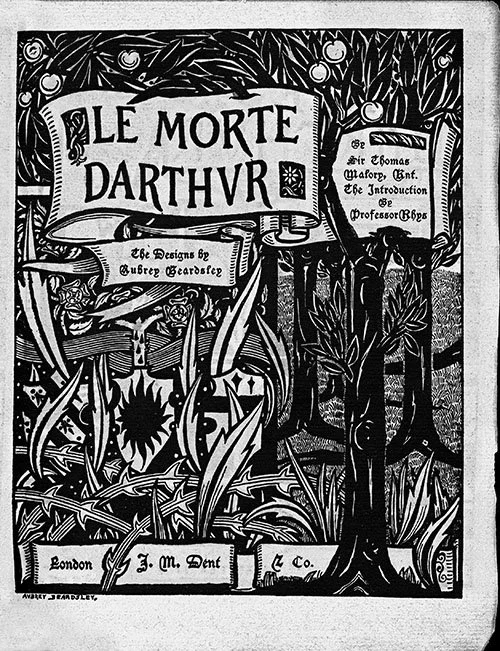
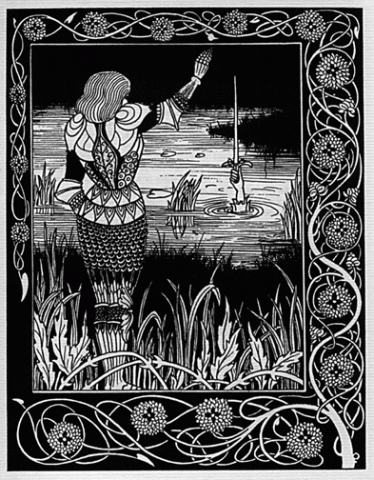
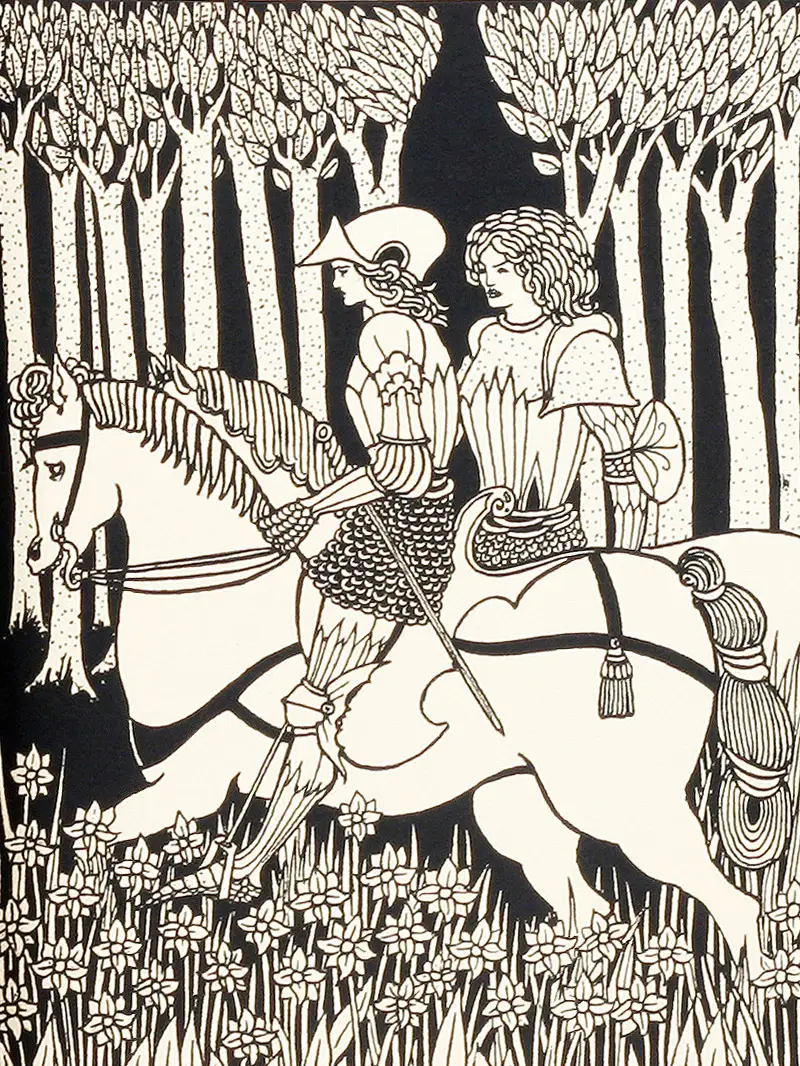
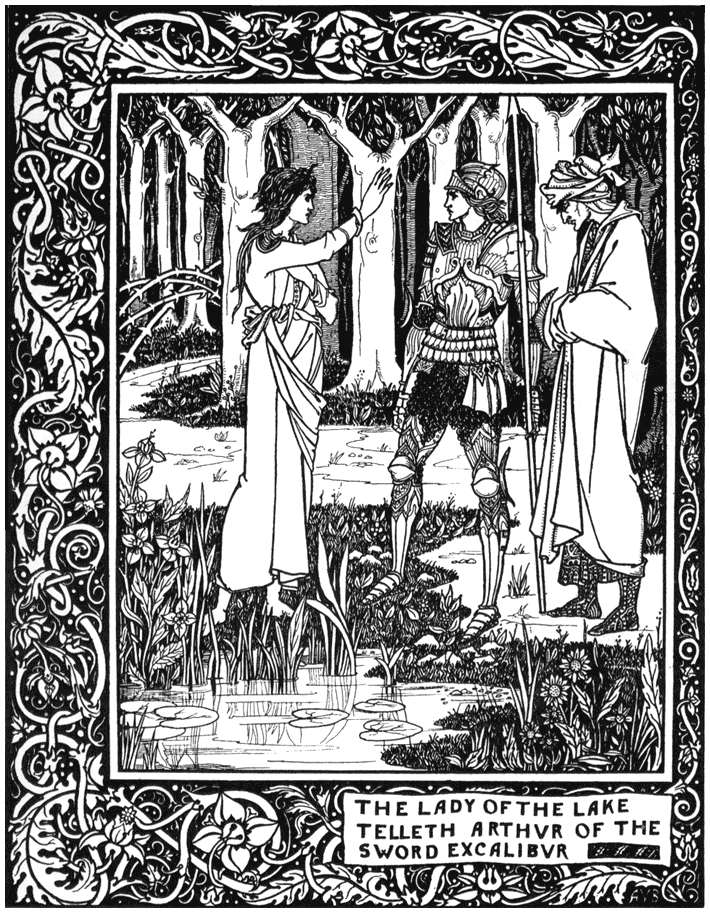
From left to right: Illustrations by Aubrey Beardsley for The Death of King Arthur by Sir Thomas Malory: the front cover; Excalibur in the Lake; How King Mark and Sir Dinadan Heard Sir Palomides II; The Lady of the Lake Telleth Arthur of the Sword Excalibur.
Recently I have been deeply inspired by the drawings of Aubrey Beardsley, and I would like to share a thought that arose from this experience.
As a small pleasure in my daily routine, I enjoy reading every morning. Today, I happened to pick up The Death of King Arthur (Le Morte d’Arthur), a book by Sir Thomas Malory that had been resting quietly at the back of our home library. Traveling through a fantasy world is always delightful—but this time, it was the illustrations that truly captivated me.
They were drawings by Aubrey Beardsley. Of course, I was immediately struck by their extraordinary precision, but as I continued to look through the illustrations, I began to notice something more fundamental.
In many of his works, the background is constructed from strong vertical and horizontal straight lines, while the figures in the foreground are drawn with remarkably soft and flowing curves. It seems that precisely because the background is so linear and strict, the beauty of the curves becomes even more vivid and expressive.
This led me to reflect on music.
At the moment, my new repertoire includes Bach and Beethoven. In their music as well, background and foreground are clearly articulated—through rhythm, harmony, and melody. Until now, I often thought in rather simple terms: for example, bring out the melody and keep everything else subdued, or in a Bach fugue, highlight the subject while keeping the inner voices quieter. However, I have come to realize that merely treating the rest as a “background” and playing it softly is not enough—and may even be a misunderstanding.
It is easy to make the most important melody louder and play everything else quietly. But composers must have placed every note, phrase, and rhythm with the same level of careful calculation that Beardsley applied to his drawings. Those surrounding elements exist precisely to make the main melody even more beautiful and meaningful.
Perhaps it would be fruitful to analyze, in musical terms, which elements correspond to Beardsley’s straight lines and which correspond to his curves.
Taking this idea one step further, there is, of course, a crucial difference: Beardsley’s drawings remain on a flat surface, while music is three-dimensional and constantly in motion. Once we understand and construct what functions as the “background/straight lines” and the “foreground/curves” within a piece, we can then use tools such as rubato and color changes to enhance these contrasts.
Rubato shaped by emotional intensity, the timing of fermatas, sounds that feel as though they are heard from memory, or tones that are clear and luminous like glass—all of these are possibilities. This applies to all composers, but perhaps especially to Bach. His music is calculated with extraordinary strictness, much like Beardsley’s straight lines, and every voice must be fully analyzed and understood in terms of its role within the whole structure. Yet, once that structure is firmly in place, what if we were to add expressive rubato as a kind of “curve”? Just as Beardsley’s straight lines allow the softness of the figures to stand out, expressive flexibility can make musical expression even richer.
Just as in Beardsley’s drawings, where the straight, disciplined lines of the background allow the softness of the figures’ curves to stand out more vividly, for instance, the contrast between structural precision and expressive flexibility in Bach’s music may be what deepens the listener’s emotional response. It is this “contrast”, I believe, that has the power to move us most deeply.
Ultimately, it is essential to clarify what we most want to communicate, to analyze the composer’s intention in which every sound carries meaning, to carefully construct the architecture of the piece—and only then to consider how we might enhance and illuminate it further.
I recently looked up Beardsley’s illustrations for Salome online and was struck by how dramatic and beautiful they are. I am sure the library has a book, and I am looking forward to going to find it.
Tap an icon below to share this blog on social media, email, or your favorite messaging app.